Speaker diarization divides a recording into time intervals attributed to different speakers. It answers which voice spoke when. Transcription supplies the words; diarization supplies the speaker labels. A label such as “Speaker 1” groups speech attributed to the same voice. It does not establish that person's name.
This distinction matters when reviewing an interview or meeting: a transcript can contain the right sentence under the wrong speaker. Correcting the sentence will not correct its attribution. NVIDIA's diarization overview describes the task as extracting voice characteristics and assigning audio segments to speaker indices.
Transcription, diarization and identity answer different questions
Imagine a recording containing the sentence “I can send the revised estimate.” Three separate outputs are possible:
- Transcription: the words “I can send the revised estimate.”
- Diarization: the sentence occurs at 00:12–00:15 and belongs to Speaker 2.
- Identity attribution: Speaker 2 is Morgan, established through additional evidence such as a known participant speaking on an isolated recording track.
The speaker number alone cannot supply the third answer. If you rename Speaker 2 to Morgan, you are adding an attribution that needs its own basis.
An introduction can help a human reviewer map a voice to a name, but the mapping still needs checking. Someone saying “Morgan will send it” is naming a colleague, not identifying themselves. If the voice is unclear, retain a neutral label or mark the attribution uncertain rather than choosing a name from the conversation.
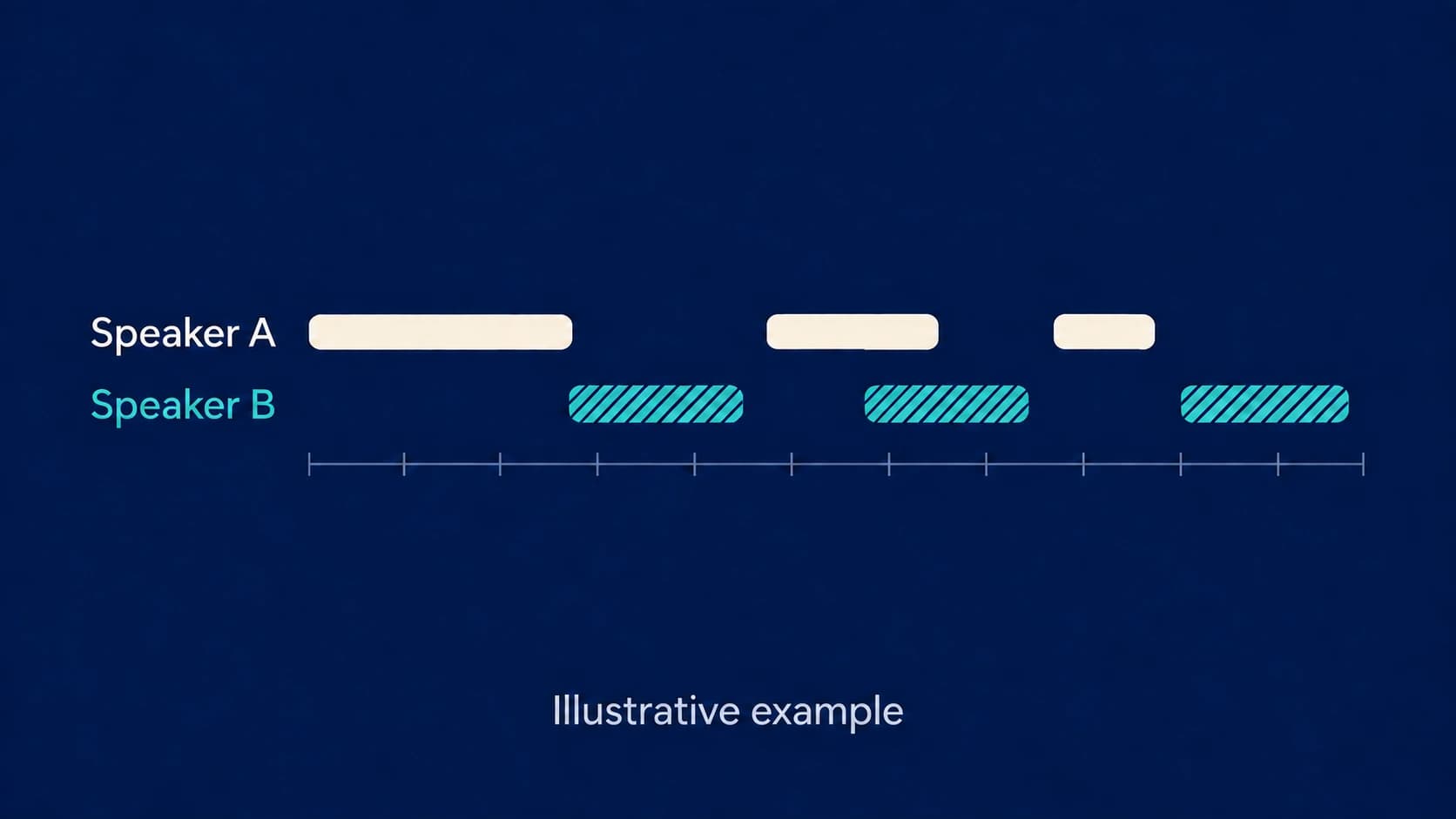
A two-speaker timeline, including an interruption
The following synthetic example uses two fictional participants and invented timings.
| Time | Speech in the example | Intended attribution |
|---|---|---|
| 00:00–00:03 | “Can you send the estimate today?” | Speaker A |
| 00:03–00:06 | “Yes, after I check the quantities.” | Speaker B |
| 00:05–00:06 | “The revised quantities?” | Speaker A, overlapping B |
| 00:06–00:08 | “Exactly.” | Speaker B |
| 00:09–00:11 | “I'll tell the client.” | Speaker A |
Between 00:05 and 00:06, both speakers are active. A display that forces every instant into one exclusive speaker turn cannot fully represent that interval. A readable transcript might put the interruption on a separate line and mark the overlap; the timing should still show that the lines occur together.
Now suppose an automatic result attributes “I'll tell the client” to Speaker B. The words remain correct, but the transcript assigns the commitment to the wrong participant. The repair is to change that turn's speaker attribution. Globally renaming Speaker B would also change the two correctly attributed replies.
There is another case that only looks like an error: one run might call the voices A and B, while another calls them B and A throughout. If the grouping is consistent, the numbering difference does not change who said what within each result. Compare the attributed voice across turns, not the label's spelling across separate runs.
How a diarization system groups voices
A modular diarization pipeline can detect speech activity, extract numerical representations of voice characteristics, then group similar segments. NVIDIA's NeMo documentation describes these stages and a later neural diarizer. It also describes end-to-end models that estimate speaker activity directly from audio. Both approaches estimate speaker activity, but organize the processing differently. Source: NVIDIA NeMo.
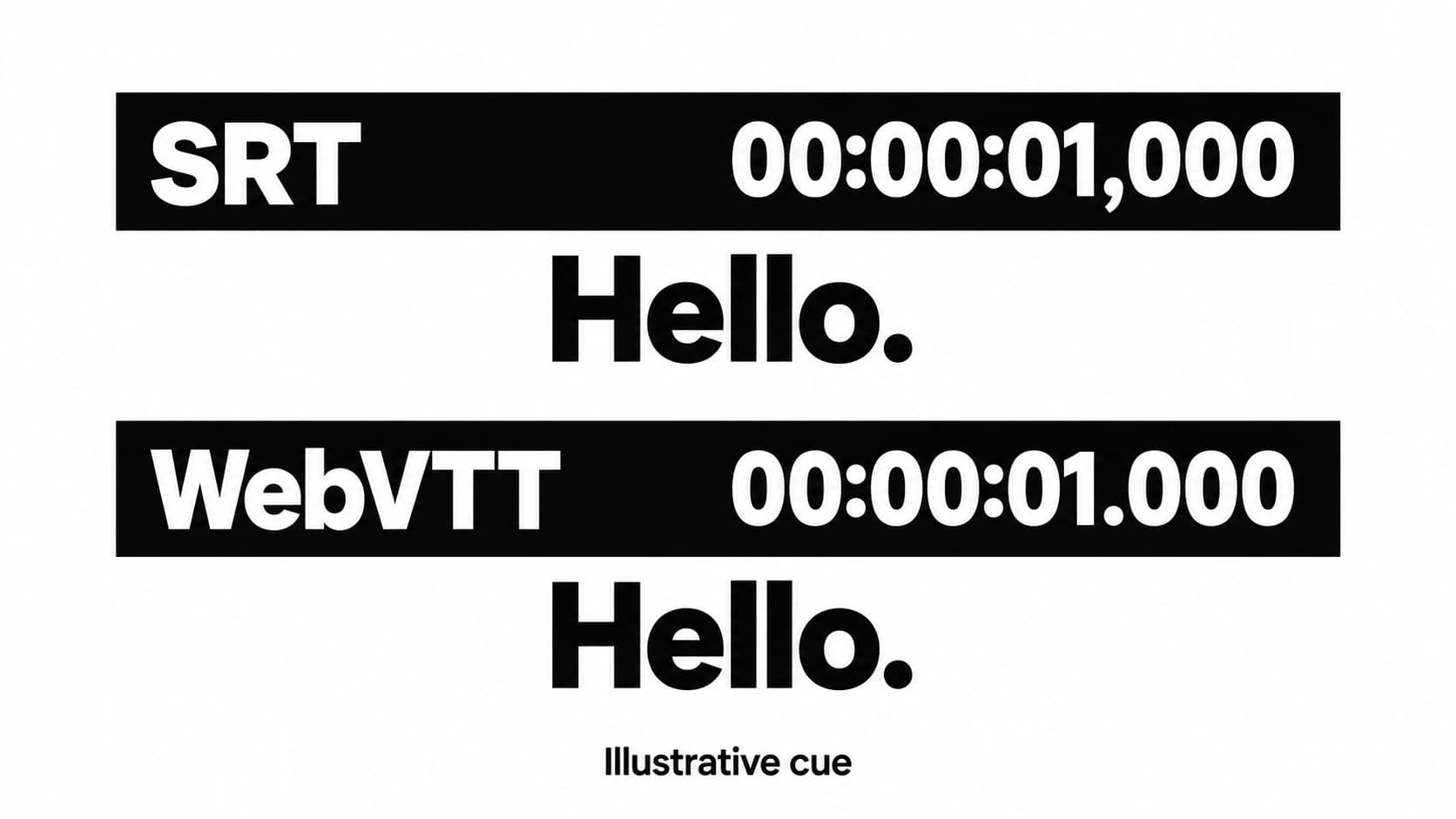
The resulting labels can be attached to words or to timed segments. For example, Google Cloud Speech-to-Text documents numbered word-level speaker labels. Amazon Transcribe documents a speaker_labels section containing speaker labels and timestamps. These are examples of output shape, not an accuracy comparison.
For a transcript you intend to edit, timestamps are useful because they let you return to the audio behind a disputed label. Plain text with names but no timing loses that convenient route back to the evidence.
Diagnose the attribution before changing labels
Use the recording to distinguish these failures.
One person appears under two labels. Compare several clear turns from each label. If they are the same voice throughout, merging the labels may be appropriate. Do not merge solely because the transcript shows more labels than expected: a brief contribution from another person may be real.
Two people share one label. A global rename cannot separate them. Replay the affected passages, split turns where the voice changes, and assign each segment separately. In the timeline above, putting every reply and the final commitment under B would hide a change of speaker.
Labels switch partway through. Find the transition and inspect the turns after it. Correct only the affected range once you have established which voice is speaking. A global A/B swap would break the earlier, correct attribution.
An interruption disappears into another person's turn. Listen around the boundary rather than to the displayed line alone. Mark both contributions when audible. If the words or voice cannot be resolved, preserve that uncertainty instead of constructing a clean exchange that the recording does not support.
There are no speaker labels at all. Confirm that the transcription request actually enabled diarization and that the selected service configuration supports it. Google's current guide points to language support and requires speaker-count bounds in its configuration. Amazon's batch workflow has a separate Speaker partitioning setting. The controls are service-specific; ordinary transcription output does not prove diarization ran. Google configuration, Amazon configuration. If you have not produced a transcript yet, the audio-file transcription guide covers choosing a processing route before you look for speaker labels.
Diarization does not reconstruct audio that was never captured. When an interval remains unintelligible on replay, changing its speaker label cannot recover the missing words.
Decide whether the labels are useful for your task
For finding a passage in a long conversation, neutral labels and timestamps may be enough. For quoting a named participant or assigning an action item, verify the relevant passage against the audio and establish the name-to-voice mapping separately.
A practical evaluation is to choose an excerpt from your own intended recording type containing a clear turn from each participant, a quick exchange and any overlap. Write a reference attribution by listening, then compare the output against it. Assess word errors and speaker errors separately: an accurate quotation assigned to the wrong person fails the attribution check.
A short excerpt can reveal a mismatch with your needs; it cannot establish whole-recording accuracy. Before relying on a named quotation, return to that specific timestamp. Keep that timestamp with the quotation so another reviewer can check the attribution.